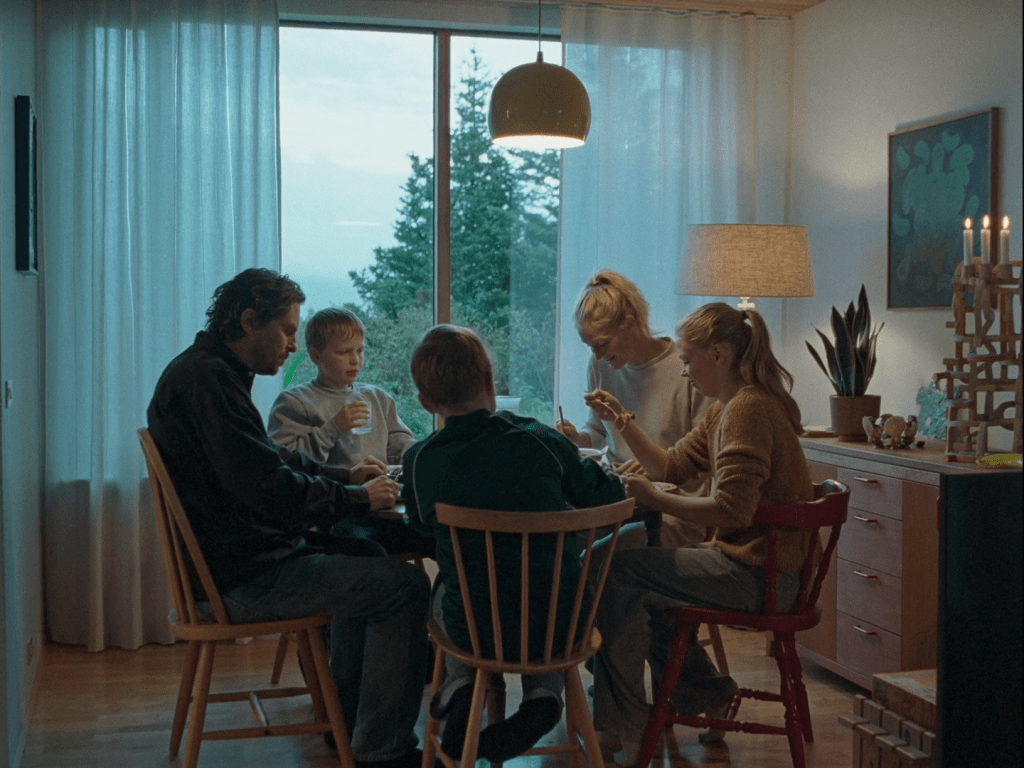
Minimalistic with cold hues, The Love That Remains begins as visual poetry, until it betrays its own aesthetic rhythm. Hlynur Pálmason’s latest feature is a tale told through contrasts, an interesting mix of what the camera allows the audience to see and what remains out of the frame.
The roof of an old building is falling apart and, in consecutive shots, is held in the air above the base of the building, as if floating by magic. This is one of the first scenes where the female lead, Anna’s (Saga Garðarsdóttir) old art studio is being demolished. Only this is assumed through the in-between shots and later visuals of the construction crane, while the very first visual of a broken roof held above an empty building remains a sort of a metaphor that’d set the tone for the whole film.
The Love That Remains tells the story of Anna and her ex-husband, fisherman Magnus (Sverrir Guðnason), as they manage their separation, three kids, and all the tangled relationships and situations around it. The film feels extremely atmospheric and lived-in while keeping the charm of narrative cinema – as if bringing together Ruben Östlund’s pragmatism and Tarkovsky’s sentimentality. The somber sound design at the beginning of the film, which is sometimes brought back for thematic consistency, also embraces this feeling by making the depictions of everyday life seem more layered and enhancing the colors of that somewhat bittersweet atmosphere.
The cold color palette, the unclutteredness of the composition, and the dialogues alike make them feel real, creating a fascinating contrast against the complexity of separation and human relationships in general. All of this is wrapped in the stark yet breathtaking beauty of rural, coastal Iceland, adding to the subtle layers of contrast the film is constructed of, which add to one another instead of creating dissonance. Doesn’t this echo life – and become yet another reason why this film’s atmosphere feels lived-in yet also perfectly and poetically constructed by juxtaposing rawness and stylization through montage?
As the plot unfolds, the audience encounters Anna’s artistic crisis, different periods of her creativity, as well as conflicting phases of the separating couple’s relationship, while the kids try to make sense of the world around them, and the seasons of harvest change, unaffected by human disarray.
All of this is beautiful until Magnus’ disturbing dreams and imagination start materializing and merging with reality on screen. Even before these surreal elements would appear, the film seems to have a set aesthetic and philosophy of not only the visuals, the story, the messages, but also the tools used to convey them. So, this additional layer seems like show-off-ing creativity through unnecessary complexity that perhaps shouldn’t belong in this narrative.
The Love That Remains is about the complex lives of ordinary people, composed of dozens of simpler layers sewn together through minimalist yet beautiful visuals. It’s the story of a woman whose life resembles an abandoned building with its roof being torn off and hanging over it through invisible threads. And that could’ve been enough.
As the amount of the imaginary increased towards the end, my initial rating of 7 went straight down to 6/10. Or, perhaps, I just don’t understand Pálmason’s humour.
Now available on Criterion Channel and Amazon Prime.


Leave a Reply