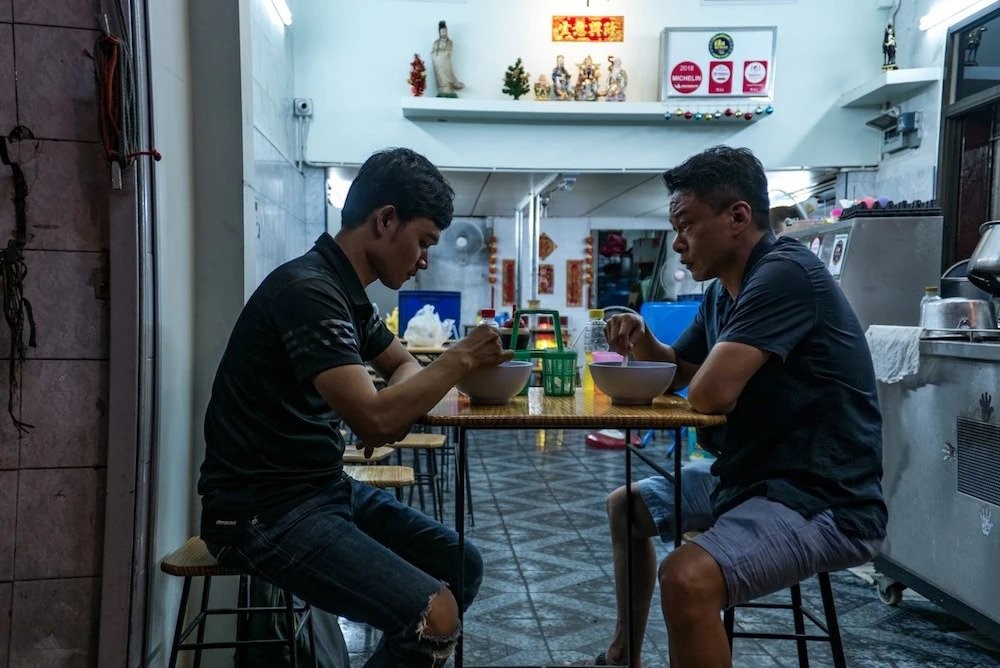
Take your notorious slow-paced filmmaking style, double it in a new film you make with your fav leading actor, enter the Berlin International Film Festival, and BOOM – you have the best recipe for a comeback as a film director – especially if you’re Tsai Ming-liang and you’ve been in “retirement” for seven years. Days is basically Tsai’s film version of popular YouTube “a week in my life” videos, only without the pretty aesthetics, twenty times deeper and intentionally unsubtitled and dialogue-free.
The film starts by observing the everyday life of two men – Kang (Lee Kang-sheng) and Non (Anong Houngheuangsy, marking the actor’s debut) through the lenses of their loneliness seasoned with 4-10 minute shots of nature, cityscapes, and the main characters simply and slowly dealing with their own existence in real-life speed instead of the usual film-speed. We encounter two types of loneliness here: Kang’s loneliness is initially concentrated in a big house and is wrapped in him being lost in his thoughts which transitions to it being his constant struggle of trying to get rid of his neck pain by burning mugwort, electrical stimulation therapy, etc. (hypothetically also reflecting on the Taiwan-based Malaysian film director’s personal struggles with panic attacks and more so Lee’s own neck problems at the time); while Non’s loneliness slowly cooks itself alongside the meal this young men is making in the kitchen of his small Bangkok apartment – at the same time making us acquainted with the local practices through every bit of movement and chopped greens.
The effect Tsai creates here is that of the life of the main characters being recorded through hidden cameras. Only, despite the Wikipedia description of the film, there is a third character here other than Kang and Non observed under the microscopic gaze of Tsai’s camera – Taiwan. From breathtaking mountaintops hidden in the clouds to the exploration of Bangkok through its streets, eateries, markets, public toilets and the people frequenting these places, Tsai, also thanks to Jhong Yuan Chang’s cinematography, makes the overcrowded Taiwan the materialization of loneliness – going outside of and becoming bigger than Kang and Non themselves.
Nevertheless, loneliness is condensed the most in a middle-of-the-movie scene showing Kang and Non’s unpredicted meeting in a hotel room, an intensely erotic 20-25-minute massage scene followed by lovemaking, shower, some after-intercourse bonding moments and dinner in the city. Simple, right? Well, without a single line of dialogue, score or too many close-ups trying to catch acted out emotions, these sequence makes Days the most real, emotional or it might be correct to say emotionally real film I’ve seen this year – especially because of the short bonding scene. Here, after seeing Kang and Non take a shower together, Tsai invites us to follow them sitting on the bed and digesting their encounter which concludes in Kang gifting Non a music box playing the theme of Chaplin’s Limelight – probably also drawing parallels between the two films, as in both an encounter of two men helps one of them with health and self-esteem, in this case – loneliness issues. I’d say though it makes the loneliness more evident. As we watch Lee follow Houngheuangsy’s character out of the hotel and them dine together in silence before parting what seems forever, we understand the gravity of their loneliness. This especially deepens as Tsai shows us these men afterwards going on with their everyday lives in their separate worlds which might never cross again. Call me sentimental, but this is the definition of both love and loneliness for a lot of ordinary people whose life stories don’t make it to the big screen – and that’s one of the main things that makes Days and Tsai Ming-liang’s condensed style in it special and beautiful. In this documentary-like film, somehow even the most boring and slow scenes that would put the western audiences to sleep, are actually easier to watch and are more impactful than any artistic masterpiece nominated for Oscars with a thick and socio-politically “relevant” plot. Maybe what makes those scenes captivating is our deep-rooted societal Asian fetish? Or maybe it’s the newly TikTok-developed urge to “romanticize everyday unaesthetic life” like some YouTubers do in their “a day/week in my life” videos…But, either way, even the process of making and eating the cheapest meals shot under seemingly amateur and weird camera angles seems to have “soul” in it in this film, making Tsai Ming-liang’s Days with its slice of life tale of urban alienation, sexuality and loneliness one of the best 2020 films that would satisfy the needs of each and every (quirky) cinephile.


Leave a Reply