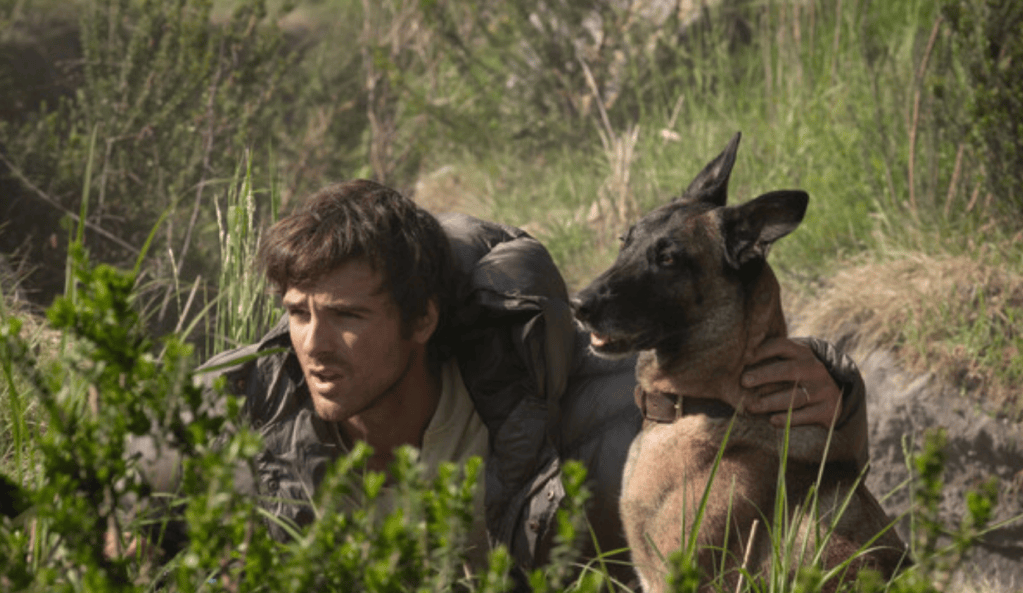
Messed-up humans, dazzling landscapes, Jacob Elordi finally playing a semi-serious role…and layers after layers of underlying political and social ugliness as the cherry on top.
My attitude towards Ridley Scott changed at least twice while watching this movie. On the surface level, The Dog Stars is a beautiful tale about the victory of humanness. However, it also weaves together so many complicated and cliché undercurrents – quite unsubtly – that one starts wanting to cut Scott’s head open and thoroughly examine his motivations and beliefs. Or, even better, the beliefs of the people funding this movie. What are you getting at, and why do you do it so cheaply?
The film takes the audience into a dystopian post-pandemic world, where the surviving few have gone back to the basics of humanity, and everything is divided into “insiders and outsiders.” Hig (Jacob Elordi), a former mechanic, lives in Erie, a bit outside of Denver. Everyone loves Hig. In a post-apocalyptic world, a man who knows how to handle a gun, cook dinners, fix electricity for the neighboring secluded Mennonite community, and desperately believes in the power of humanness – is gold. Hig lives with his dog Jasper and shares his territory with a man named Bangley (Josh Brolin), a former Marine who uses his sniper skills to protect their land from invaders, while Hig does the same, flying the skies around them.
The color palette is cold, framing the wide shots of Colorado landscapes pretty breathtakingly, while a lot of inside shots turn to using dirty yellows and muted grays – as is so typical of apocalyptic movies. In this beautifully lifeless scenery, the only things that keep our hero going are the memories of his deceased wife Melissa (Sai Bennett) and his dog Jasper. Oh yes, also he has named some constellations after Jasper. They like to lie on the grass and watch the stars – how romantic…The film’s landscapes promise freedom, while the people operate on isolation and fear. The perfect American dream.
And once the dog dies during an invasion, Hig decides to fly away and find the Grand Junction, whose signal he had picked up, in search of other humans…or, if that fails, fly his plane into a mountain and die. On his journey, he meets a farmer (Guy Pearce) and his daughter Cima (Margaret Qualley), fights “outsider” attacks with them, finds the Great Junction, which (spoiler) ends up being a cult of cannibals, and returns to Erie.
Now, about these “outsiders.” At the beginning of the movie, this is claimed to be a group called the “Reapers” who come “from Texas and Mexico” and kill anyone who hasn’t died from the pandemic. Later, as they attack Bangley while Hig is gone, and Cima’s house, the audience gets acquainted with tribal looking people, reminiscent of American Indians in their appearance. And not only the appearance. They are portrayed as zombie-like, while also embodying the stereotypical behavior white films have years on end attached to “savages.” Why the racism? And, this is so uncoincidental…the “outsiders” from behind the Wall who are the villainous savage zombies…how politically convenient for whatever’s going on in the U.S. No? Plus, the inherited genre conventions and lack of originality…
Moreover, the cannibals at the Great Junction who lure people and either use their skills or kill them – a group of the elites who survive in an oasis-like secluded territory. Oh, please! Is there anything more cliché than this? Ridley Scott, even if you were going to put some conspiracy theories on our screens – no matter if it confirms anything or not – it could’ve been done with a little more elegance and better worldbuilding. And to make those “humans” cite the Bible…why? Another villainization?
Also, the Mennonites whom Bangley keeps confusing with Mormons and whose community becomes the final haven in the territory…this movie is overflowing with political and social messages relevant to today’s West (I’m trying not to say America) to the point that it makes me nauseous. Yes, the post-apocalyptic world is an eerily relevant setting; yes, there is a lot of messed up stuff going on around the world, but, Mr Scott, to mix all of this in a soup like this? Without developing your characters enough? I haven’t read Peter Heller’s book of the same name that this is based on, so I’m only judging what I saw in the theater.
Finally, ending the movie with Cima and Hig finally letting go of their ghosts and giving romance another chance, and returning to that message about the victory of humanness…that’s cute, but is it a happy ending? Does it give hope that humanness will save us in the end? Or, would it have been more realistic for Hig to go crush his plane against the mountain as he was planning to, showing that after going through so much mess, one cannot stay sane? What is actually your point, Ridley Scott?


Leave a Reply