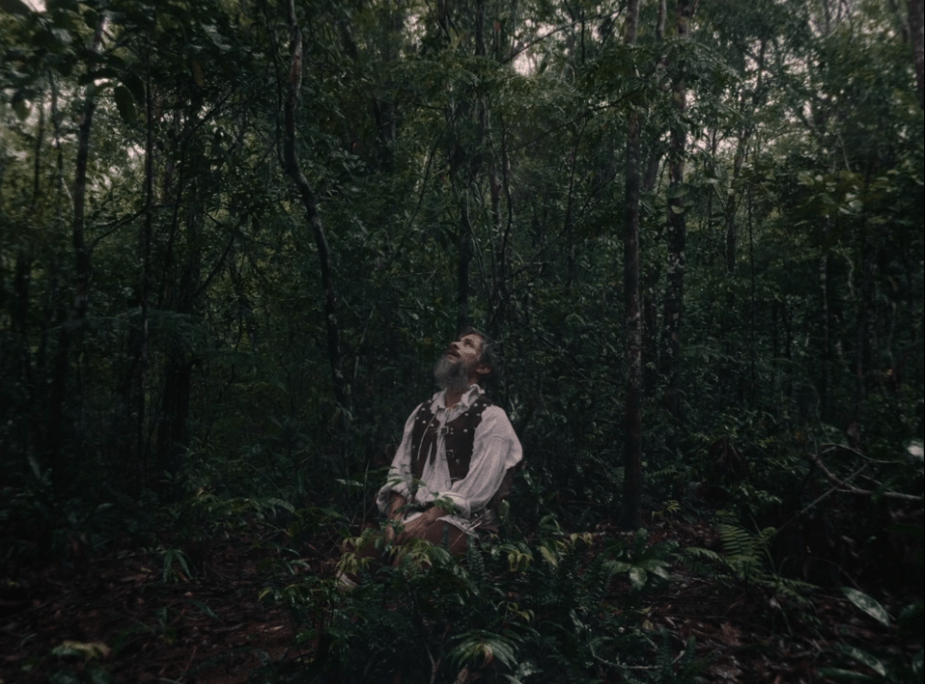
Philippine spirit unconquered. Through layers of shadows, languages, and landscape, human and non-human perspectives, and a camera that shows the minuscule-ness of man against the giant of nature, Lav Diaz uses Magellan to shift Eurocentric narratives of colonization.
In almost three hours, Magellan presents its audience with what feels like the lost footage of anti-imperialist myths from the “age of discovery.” Following Ferdinand Magellan’s (Gael García Bernal) 16th-century expedition, Diaz’s camera seems not only to rewrite the human point of view but also to tell the story witnessed by the lands, forests, and seas of Southeast Asia.
Slow and steady, the camera often observes from a distance, letting the carefully chosen frames reveal the uncanny balance between the land’s ageless beauty and the atrocities of human doing it was forced to be stained by and carry.
Should the audience sympathize with Magellan or despise him? The sense of unease and unbelonging in the narrative spaces that Gael García Bernal’s performance transmits also puts the viewer on the fence about a moral judgement of Magellan’s character, perhaps not seeing him as solely a hero or a villain, but human.
Pawns in the hands of King Manuel and the relentless ideologies of the time, Magellan and his allies are silently ridiculed in Lav Diaz’s depiction, as one after another, their grandiose speeches of conquest hit dead ends. These characters become real in Magellan, flawed, scared, and small compared to the land they aspire to – visually and narratively.
Layers of Filipino sorrow and faith unveiled.
Lav Diaz produced Magellan after 7 years of research, trying to truthfully depict what was not written, what was left to be forgotten. In an interview for Criterion Channel, Diaz explains he uses his films not to let Filipinos forget “that history is a long-standing trauma…that the fractures of colonialism, of imperialism, of the impositions that never truly belonged to the Filipinos, will always remain.”[1] As such, Magellan is definitely one of his finest.
With prayer and desecration, beauty and grotesqueness, life and death, history and anti-history, Magellan is a compilation of contradictions woven together with a certain subtlety only typical of Diaz. Not hard to sit through, despite its nearly three-hour runtime, this is easily the most beautifully daunting film I’ve seen this year. Now playing on Criterion Channel
[1] “Magellan – Meet the Filmmakers: Lav Diaz.” The Criterion Collection, 2026, https://www.criterionchannel.com/magellan/videos/lav-diaz-interview.


Leave a Reply