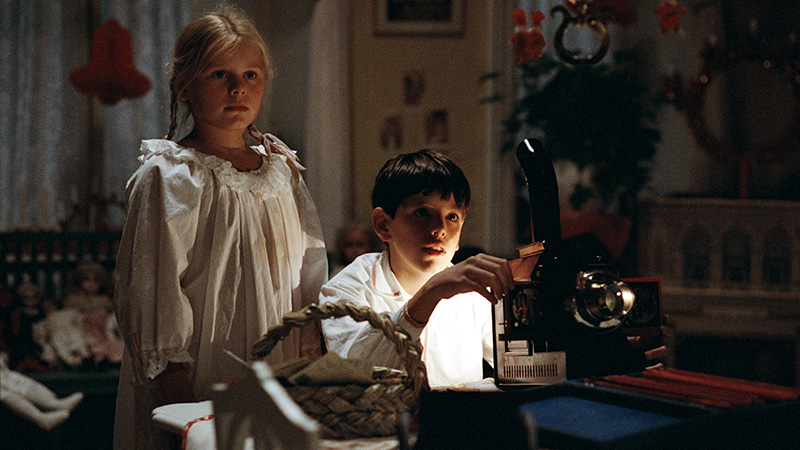
With all the commercial crap going on on Netflix, do ‘pure Christmas’ movies still exist? And, I’m not talking about the cheesy Hallmark kind. But, ones that captured the spirit of the holiday. Ingmar Bergman’s Fanny and Alexander (1982) is that sort of movie. Perhaps one of the favorite holiday movies of Bergman fans, yet not the first one that comes to mind when one thinks of Ingmar Bergman – you know, at least it wouldn’t beat Persona (1966) or The Seventh Seal (1957) in popularity!
Following the big dinner at the grandmother’s house in Uppsala, Sweden setting the scene, the story is told from the perspective of the ten-year-old Alexander Ekdahl (Bertil Guve). As the first act lasts 50 minutes until the inciting incident happens – Fanny (Pernilla Allwin) and Alexander (Bertil Guve) Ekdahls’ father’s death, finally setting the story in motion. Fanny and Alexander’s mother Emelie Ekdahl (Ewa Fröling) re-marries an unreasonably strict Bishop Edvard Vergérus (Jan Malmsjö) who not only locks the family away in his ‘castle’ but makes them fully strip clean from their old beliefs, traditions, and family and friend ties. As the situation escalates, the Ekdahls are forced to kidnap Alexander and Fanny to save them from the bishop. And, while the step-father negotiates their return, an unfortunate incident sets the bishop’s sister and himself on fire – who, deep in sleep from the pills Emelie had given him, planning to run away after Edvard refuses to grant her a divorce. After all is said and done, Emelie, Alexander, and Fanny reunite with the Ekdahl family who then decide to raise Emelie and the late Bishop Edvard’s newborn twins as their own.
All in all – reason wins over faith, the material values win over spiritual ones – this is the film’s message. Although, from Bergman’s tone, it’s hard to distinguish which one he advocates for. This movie, like many others of Ingmar Bergman, such as The Silence (1963), Persona (1988), The Seventh Seal (1957), Shame (1967), and The Touch (1970), is the director’s way of exploring the unexplainable: the good and evil, the existence of God, the righteousness of the church, and all sorts of mysticism – such as the recurring theme of ghosts as a red thread throughout the film: the children often see their father’s ghost dressed in white, which echoes the role he had in the Nativity play before dying; at the bishop’s house, Alexander claims to have seen Edvards’s first wife and children’s ghosts; etc. Then there’s magic – one with which Alexander apparently murders his stepfather (hence the unfortunate incident). But God? Does God exist? What’s right and what isn’t? Bergman seems to blur the lines, exploring and challenging his own beliefs, and guiding the audience to do the same.
One way or the other, this film seems to be a 7/10 to me – very European, very uncanny, a bit quirky, and absolutely filled with the traditional festive spirit. I might not rate this as my favorite Christmas movie of all time, but it would definitely give cinephiles a lot to talk about and debate amid the holidays.


Leave a Reply