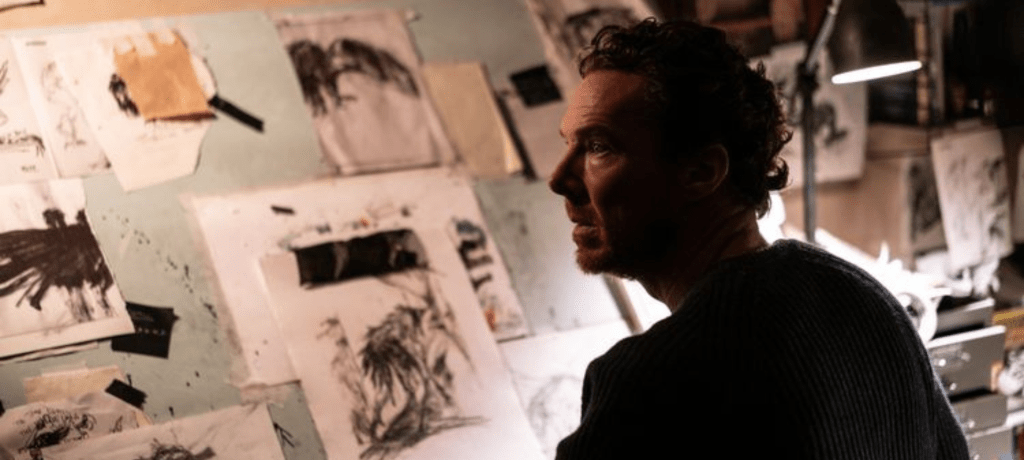
Creative people are weirdos even when it comes to grieving – even films show it now. The Thing With Feathers mixes the raw reality of losing a loved one with a curious way of showing the material manifestation of its psychological side.
Based on Max Porter’s novel Grief Is The Thing With Feathers, Dylan Southern’s film tells the story of a dad (Benedict Cumberbatch) whose grief materializes through his creative processes and takes the form of a Crow (Eric Lampaert), while he tries to help his two sons process their mother’s death.
Representing the dad’s inner dialogue, the crow looks like a fragment from our worst nightmares, adding a psychological fantasy horror element to this drama. In order to balance this imaginary part, the filmmakers have made everything else hyper-realistic: gloomy color-palette true to London and the film’s mood, masterfully designed and believably messy interiors, and poignant silences and breakdowns in dialogues…including an eerie voice in dad’s head, exploiting the darker layers of his subconscious that are awakened by grief. Until it takes the form of a black Crow – a character that had haunted his sketches for sometime, while he worked on a book.
The father struggles to emotionally regulate himself and his kids, sends them away, goes to therapy, draws, fights with the Crow…and slowly goes insane. Other than his grief, the Crow also represents father’s inner dialogue with his creative process, as he turns his grief into a piece of art, trying to get it out and over with. The line between imaginary and real gets blurred further for the audience, as the kids also see traces of the Crow. It becomes a collective grief symbol, mothers them when the father cannot… despairs them. The more real it becomes, the deeper into the dad’s psyche we are transported.
Acting is brilliant, Cumberbatch seems to be born for the role (just like for almost any role he plays), and the kids (Richard Boxall, Henry Boxall) do an amazing job as well. On one hand, this is a moving tale of how deeply creative people process their emotions and thoughts, on the other hand, the fact that a film made in 2025 needs to portray emotional instability in such an exaggerated way in order to beat the modern trend of nonchalantness and “celebration of individualism,” and convey how much people actually need people, and how deep grief can run, shows the type of rotten world we live in.
Some think it’s easy for creative people, cause they have the devices to process their emotions through art, alchemists who turn tragedy into genius. Yet, sometimes, this alchemy destroys them from within, making their minds the most hostile place to inhabit, invaded by predator birds.
Bloody horror scenes, blurry lines, and finally light: the widow publishes a comic based on all the fights with Crow. Creative process is over, horror disappears.
As much as I understand this process, appreciate how much work has been put into not making the inner-dialogue-come-alive into a cliche, and keep the audience on their toes, and admire the acting, I am still not convinced of this film’s genius. It’s more of a desperate scream of the soul rather than a film that says something influential. However, in a time when the decline of cinema manifests in either overly-simplified background watches, or perverse ridicules of art, like Emerald Fennel’s Wuthering Heights (2026), The Thing With Feathers at least gives food for thought, which puts it above average.

 Light-Tinted Lens
Leave a comment