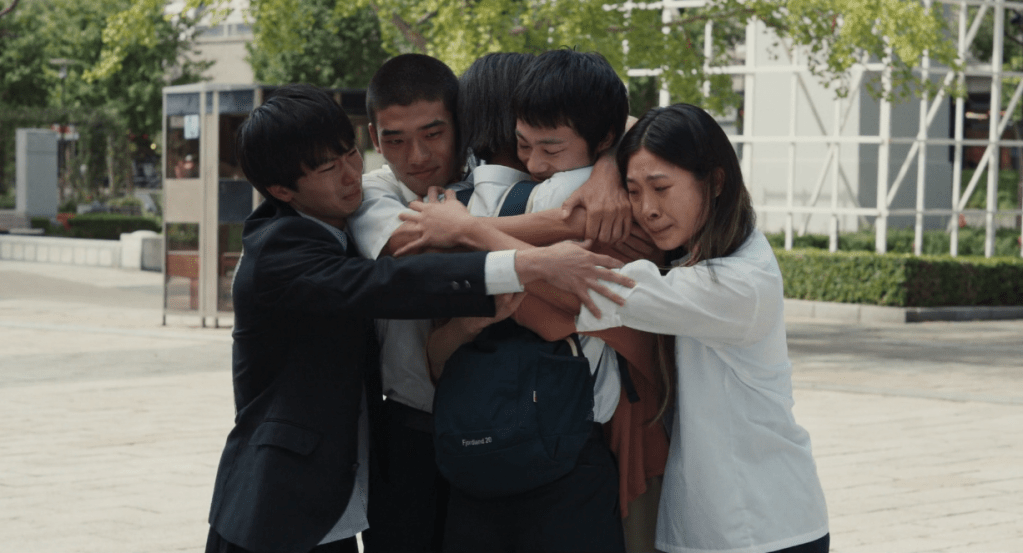
People have power, yet this realization often fades like a fleeting dream as we move through our teenage years. In his debut feature, Happyend (2024), Neo Sora shows the teenage spirit – sometimes rebellious, yet also human – manifested within school walls as a microcosm of society.
Tokyo, near future, a dystopian reality that seems more like a prediction than sci-fi. A group of high school friends live their life to the fullest: sneaking into underground raves; secretly partying in their school after hours, calling it “music research club” meetings; and even pranking the headmaster with the over-the-top capitalistic mindset. Their minds are not yet colonized by myths of order. This is especially true about the two best friends and the main characters of the film, Yuta (Hayao Kurihara) and Kou (Youkito Hidaka), who dream of becoming DJs.
Nevertheless, the stunts these kids pull are pretty conscious attempts to escape the anxieties about the future, the stressful lives of the adults, and the constant fear of earthquakes. But, worst of all is the state of hopelessness among people who are done fighting the government and the ever-evolving systems of surveillance, racism, and classism, which have worsened in this imagined future Tokyo.
The main conflict of the story occurs when the school installs a new AI surveillance system in school called “Panopty” (pretty on the nose with this one, no?). These cameras have face/body recognition settings and take points from students for every small thing – from untidy uniforms to smoking to even walking in the hallway during classtime. Eventually, the school removes all the equipment from the friends’ “music research club” room to teach them a lesson for all their pranks, which only escalates everything.
A lot of the time, the camera works from afar or captures the characters from the side, as if being one of the surveillance cameras. Except a couple of interesting cinematographic solutions, like filming the shadows talking instead of people, or using lots of frames within frames that reinforce the analogy of the panopticon prison, the overall cinematography is not much stylized. Simple and effective. So is the music – pretty subtle, other than one pub song some of the characters repeat throughout the film, a famous line being “the most important person in the world is a computer.”
To tell the truth, this song is only the tip of the iceberg of how obvious everything in this film is. It literally portrays all the current fears we have about the future with AI, only through the eyes of teenagers, which makes it more relatable and honest-looking. It really is a microcosm of society – some kids fight for their rights, some are too scared, some follow the rules cause they believe in the power of order. Heroes, traitors, cowards, impartials.
Under the leadership of one of their classmates, Fumi (Kilala Inori), an idealist protester girl, a group of discriminated students petition the principal to remove Panopty. After many hours that contained yet another layer of society-imitation, the principal (Shiro Sano) gives in. Hooray.
What actually makes this film sci-fi is the happy ending. Cause, overall, it grew on me as I kept watching. Though the first half of the movie I was not sure this would be more than 5/10 or at most 5.5, I was set up to be pleasantly surprised. It feels so on the nose exactly because it is so relatable. It’s a real tale about real people, even if it’s set in the future. Real kids who need to choose between lowering their expectations and having fun until the world ends, or fighting for what they believe in and adulting, fully understanding things might not change. Other than the fairytale happyend, of course, where they actually change:)
And, even though all of this has been said and done in much more complex and artistically challenging ways, from Chaplin’s Modern Times (1936) to Tarkovsky’s Stalker (1979), Neo Sora’s Happyend has been an official selection at some of the major film festivals, such as tiff, Venice, NYFF. It has also gotten extreme praise in major magazines like Parade, The Hollywood Reporter, The Wrap. And, perhaps, it is radical and groundbreakingly genius for today’s day and age, and I should stop looking for the depth and layering of the films long gone.
Overall, I’m giving this something between 6.5 and 7. It aired on Criterion Channel on Feb 10, 2026, and is ready to be watched, admired, and critiqued.

 Light-Tinted Lens
Leave a comment