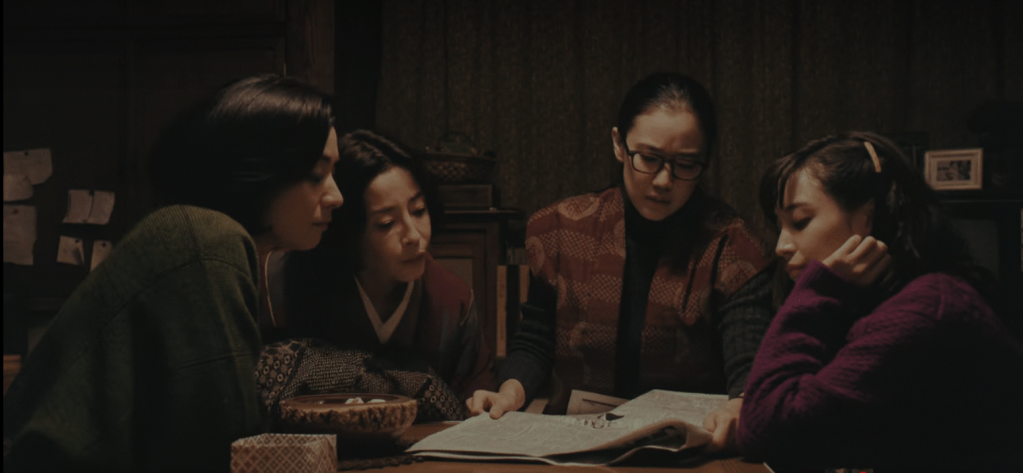
Affairs, affairs everywhere – this seems to be the theme of Hirokazu Kore-eda’s new TV series Asura. Was it also that of 1979 Tokyo or is it Kore-eda’s subjective depiction?
Asura brings in nostalgia, intrigue, subtle humour, complex family dynamics, and the charm of slice-of-life sceneries, true to Hirokazu Kore-eda’s style. When four sisters discover their seventy-year-old father is cheating on their mother, their own complicated lives come to light. Using cheating husbands, wives, mistresses, and widows as the main theme of his TV series, Kore-eda also brings to light various layers of the mindset, traditions, and lifestyle of 1979 Tokyo.
In many ways every second of Asura shows the extreme misogyny present in this mindset: a man’s affair is considered a norm, and the woman has to stay silent if she wants to keep the peace and the roof over her head; women are portrayed as victims with no much choice other than to forgive and serve men; and men seem to get away with anything – even the death of their wives caused by the deep grief of loneliness, like the mother of the four sisters (spoiler, sorry!)
In most of the first two episodes, the four sisters do their best to conceal their father’s affair to save their mother’s heart and sanity, only to find out she knew about it all 10 years and didn’t say a word. Yet, her peacefulness and silence were not wisdom but a facade holding many layers of toxic cultural norms and helplessness. As the series unveils the affairs of the sisters’ partners or even the eldest sister herself, Kore-eda draws parallels between two generations, showing the staleness of the said mindset, and the comedy and tragedy in it.
The actors’ performance is very believable, with a pinch of cynicism, echoing the overall absurdity of the reality these people live in. Yet, the Tokyo Kore-eda shows, no matter how fictional, does succeed to capture the audience’s hearts with the uncanny balance between its toxicity and stillness wrapped in formal etiquette and kimonos.
Familial relationships, philosophical questions, the dynamic between two generations, life and death, the lengths people go through to make ends meet, career problems – all of these are themes commonly present in Hirokazu Koreeda’s older films such as Still Walking (2008), Shoplifters (2018), After Life (1998) as well – which are some of my favorite films of his, in that order.
At the end of the third episode, as the family leaves the mother’s funeral, one of the sisters’ partners recites an excerpt from Natsume Soseki’s Gubijunso: “This world holds only comedy. Tragedy is greater than comedy. Millet or rice? Such is comedy. That woman or this woman. Such too is comedy. English or German? Such too is comedy. All is comedy. In the end, one question remains. Life or death. Such is tragedy.” This pretty much summarizes the plot of the 1st three episodes and, perhaps, the whole series, keeping up with Kore-eda’s genius found in simplicity.
Interestingly, that genius became apparent to me only after learning who the director was. Watching half an episode of Asura this summer, I didn’t think much of it. Every single thing I listed as artful or “genius,” didn’t catch my eye until recently, when I learned the director is Hirokazu Kore-eda, and, being acquainted with his style, I started watching the series through his lens. Maybe it’s not professional of me, or it just shows the subjectivity of our perception. But, either way, I’m glad I got to watch this series.
And, as my favorite directors – first, Wong Kar-wai, now Kore-eda, choose to make series, I start to wonder if the overall direction of cinema is changing, and we’re shifting from cheap sitcoms to more artful series with good plots and cinematography. Or, does this shift just prove that more accessible forms of cinema, like series, have and will always be more profitable?

 Light-Tinted Lens
Leave a comment