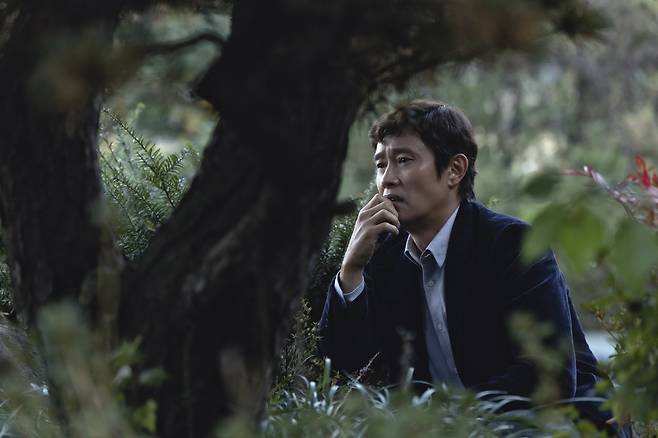
Survival of the fittest – in the workplace and society alike, especially in the age of AI. And, in the filmmaking world, Park Chan-wook is definitely still one of the “fittest” as this is the oversimplified message of his new film No Other Choice (2025).
This film is a delicious cake with multiple layers of social commentary and satire. And, the cherry on top is Park Chan-wook’s distinguished style with the suspense, classical music-filled score and creative parallel shots of the characters that add to the deliberately crafted pacing of the film.
Even if not as sharp as Park Chan-wook’s previous films and perhaps lacking the mystery and subtlety of his usual cinema, this is still a brilliant movie stand-alone.
No Other Choice tells the story of Yoo Man-soo (Lee Byung-hun) – a devoted family man and a paper industry specialist – who loses his job and needs to get back in the game and provide for his family – no matter what the cost.
The family struggles a lot. There’s Yoo Mi-ri (Son Ye-jin) and her teenage son from a previous marriage, and Man-soo and Mi-ri’s little daughter. As Man-soo jumps from one new job to another unable to land a solid one, the family’s savings slowly melt away. The couple quits their dance lessons; Mi-ri is forced to stop her tennis practice and get a part-time job as a dental hygienist; Man-soo’s childhood home which he worked so hard to repurchase it – is under the risk of being sold so the family can pay off their loans. Finally, they are no longer able to “feed so many mouths” – so the family “lends” their two gorgeous dogs to the grandparents until Man-soo is able to find a new job – almost sending the little girl into depression. Most tragically is the fact that this girl is a genius cello player in need of a professional professor whom, at the moment, the family cannot afford – deepening the pressure on Man-soo to find a solution out of the financial pit they are in.
Here we encounter the first layer of Park Chan-wook’s social commentary: the societal pressure on the husband to “be the man of the house,” provide and carry the whole weight on his shoulders – and the fact that the failure of doing this can send him into a state of anxiety, depression and a full loss of self-worth. A bit exaggerated, Park Chan-wook perhaps extends his pity and empathy for men who are ready and capable of doing anything to keep their families happy – and I mean anything – especially in today’s age when the institution of marriage seems to fall apart. This extends onto marital relations, unfatefulness and ungratefulness of some wives who divorce their husbands over a small inconvenience – and the creation of this “perfect wife” archetype Park Chan-wook makes out of Mi-ri – the woman who stays next to his husband even after discovering his serial killings. Oops – spoiler!
Yes, so, desperate to find a job and not just any job – but one corresponding to his profession – the paper industry – Man-soo plots the death of not only the leading paper-specialist in a leading company – but finds a way to detect and eliminate anyone who could’ve been hired in the position of the “missing person.” When all is said and done, Man-soo lands a job as a supervisor of the machines in the company – the only one who is going to be working after all the other coworkers get fired due to the development of new AI-powered machines. The family gets their old lifestyle back, the little girl plays the cello – everyone’s happy – and the tracks of any “wrongdoing” are masterfully concealed with love and devotion of the couple – and a little bit of luck.
Here, the second layer of obvious social commentary is the choice of paper as the core of the film and the main character’s field of expertise – a dying and replaceable thing today, just like jobs – any and all jobs which are at risk of dying with the development of AI. The movie starts with Man-soo complaining how unfair it is to dispose of the long-term workers just like that – yet in the end, when informed that hiring him as a machine supervisor would mean disposing of all the other human workers, Man-soo still gladly takes the job. As obvious as dual commentary is, it is nice to see how Park Chan-wook uses his art to address the rising crisis in the jobmarket and the fear (and the reality) of many of being replaced by the Machine – as well as Park’s commentary on the egotistical human nature itself.
All in all, I don’t think this film would ever become a classic and is not even close to Park Chan-wook’s more famous films like Oldboy (2003), The Handmaiden (2016) – or even Decision to Leave (2022). It is not even a film that I would ever rewatch. However, it is a good reflection of the times we live in, a good cultural and social commentary – and, as such, it does its job well!
P.S. My final question would be – is this just a weaker film in Park Chan-wook’s portfolio, an exception proving the rule of his genius, or a decline in creativity from which the director will not recover?

 Light-Tinted Lens
Leave a comment