A classic biopic. One would think Monsieur Aznavour‘s formula is like that of any other: tragic childhood, ambition, a big sponsor, personal scandals, sacrifices, some cheesy moments of self-doubt, and, finally, fame. Yet, this monsieur is much more layered – his pure Armenianness being an undeniable part of it all. Knowing about Charles Aznavour all my life as one of the greatest French-Armenian singer-songwriters, I’ve only seen him as an old grandpa – cheerful, with kind eyes, and a long list of genius world-known songs…so, seeing his character and life story on screen, both made me accept him as a flawed human being and take him off the pedestal I had put him on AND put him on a taller one – for this movie, made by French directors Mehdi Idir and Grand Corps Malade, made me incredibly proud to be Armenian.
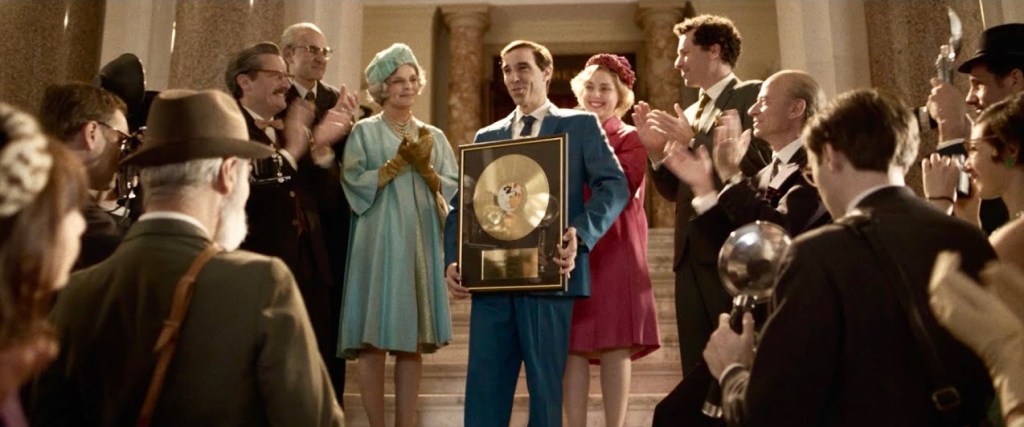
Monsieur Aznavour is divided into 5 chapters: les deux guitares; sa jeunesse; la bohème; je m’voyais déjà; emmenez-moi – echoing the names of Charles’ albums. One of the first scenes of the movie includes a cliché but powerful montage showcasing where the singer got his inspiration: slow-motion dances of Charles’ (Tahar Rahim) parents dancing under ‘les deux guitares,’ morphing into Charles Aznavour’s voice singing the same song as an adult, accompanied with real-life footage of Armenian immigrants escaping the 1915 genocide and getting to France on ships – hinting the Aznavourian family’s story. Changing his name from Aznavourian to Aznavour for better assimilation in French society and show business, Charles starts performing from a young age as well – just like his older sister Aida (Camille Moutawakil). They are not only inspired by their immigrant parents’ artistic nature, but also their need for extra cash. Already a young man, tired of doing covers of others’ songs, fate crosses Charles’ path with Pierre Roche (Bastien Bouillon), a talented pianist-composer, and together they start writing their own songs, performing in cabarets…until fate smiles at them again and they meet Edith Piaf (Marie-Julie Baup) who becomes their new sponsor, Charles being her favorite. Charles soon marries Micheline Rugel (Ella Pellegrini), but while she’s home pregnant and later taking care of their daughter Seda like a single mother – Aznavour goes on tours and spends his time (and has a good time!) with Pierre and Edith, while a song most probably inspired by those events is heard in the background. The editor’s style is clean and clear, very much balanced with the music design: a lot of great transitions, a lot of montage scenes accompanied by Charles’ songs in the background that are reflections on those moments in the singer’s life – just like the hardships he endures are accompanied by Dle Yaman, an Armenian music piece performed with duduk. With the help of Raoul Breton (Luc Antoni), a popular French publisher, the ‘Roche and Aznavour’ duet tries following Piaf to New York for a tour, yet is stopped at immigration for not having visas (ah, that’s so adorable actually – young and naive boys, rushing after their dreams, without even a care about how the world works). Finally, saved by Piaf, they are sent by her to Montreal, where they perform at night clubs, including Au Faisan Doré…until Pierre decides to get married. While back in France for the wedding, Piaf convinces Charles to leave Pierre, as well as his wife (to whom he was long been unfaithful), to remain in France and work on advancing his own career. One thing Edith had not mentioned – she didn’t quite mean Charles was going to operate his Armenian nose ‘to look more French’ and remain in France to work on his image as a singer…but as a songwriter for her, as well as her chauffeur. What Piaf didn’t know either was that one day Charles was going to leash out, stop living with her, and quit working for her and collaborating altogether – determined to go chase his dream of becoming a star. And, that he does! “I’ll write 1 song a day and will sing until my throat breaks.” Charles takes risks: concert after concert even when there are only a handful of people in the audience and he’s on the verge of bankruptcy, ups, and downs, the reveal of how his song Parce Que Tu Crois (1966) inspired Dr. Dre’s What’s the Difference (1999), as Aznavour’s song morphs into the famous rap song which effectively plays in the background, while the audience sees a montage of Aznavour reaching his peak – his first vinyl disk with a word in the back from Charles Trenet – a good coming-full-circle moment in the movie, as Trenet was one of the first artists whose songs Charles was covering at night clubs to earn some money; then come wealth and fame: from mansions, lots of lady fans, buying property for his parents and Aida, and finally fully taking care of them financially, concerts in Paris’s Olympia and New York’s Carnegie Hall, to the reveal of his ‘lost son’ (who then tragically dies in his youth), his songs being translated into multiple languages, and tours all over the world, him finally starting a family with the love of his life, swede Ulla (Petra Silander), and finally getting as much paycheck as Frank Sinatra (Rupert Wynne-James) – fulfilling one of the dreams of his youth.
The film ends with his song Hier Encore in the background and real-life footage of Aznavour at an older age, still singing, including some footage from the tragic 1988 Spitak Earthquake in Armenia, after which Aznavour recorded his famous song Pour toi Arménie and started his “Aznavour for Armenia” foundation to raise money for aid.
Overall, it’s a good, classic biopic, a solid 7.5/10. Yet, it definitely touched the hearts and souls of all Aznavour fans, and definitely all Armenians. Besides, Tahar Rahim does an extraordinary job portraying Aznavour. Although he’s far taller rough in his movements than Aznavour seemed to be in real life, yet at certain angles he looks EXACTLY like Charles Aznavour.
When discussing it with my younger cousin, she said that what stuck with her was how the film captured Aznavour’s Armenianness: in one of the final scenes of the movie, during a conversation with his sister, they remember their father’s words – always positive and hopeful: “look at where we were and where we got”…yet for Charles this new mountaintop he has conquered feels like a foreign land – he’s not used to it; he wants to keep working even though stars who get to the top as he did can relax and just reap the fruit of their labor…but not Aznavour. He wants to make sure everyone in his family is taken care of – that is why he had started performing in the first place since he was a little kid, always giving every cent he earned to his parents. I had not caught on this at first, but I fully agree with my cousin, that the core of who Armenians are – family is sacred for us, we’d do anything for our loved ones – that’s part of our culture, our identity…and it was part of Charles’, even if he was known as “the legend of French chanson.”
P.S. Ok, not seem awfully biased (because I am), let me say that this film is definitely not a masterpiece. But it’s objectively better than mediocre movies – you know, the ones that are good in all aspects but are not extraordinary in any sense. Now, this movie is not extraordinary either, but it does come close to being a classic. HEY! Charles Aznavour himself has approved of the script when he was still alive! So, call me as biased as you want, but this movie is definitely better than the American biopics based on scandals and false information like Andrew Dominik’s Blonde – the 2022 biopic on Merilyn Monroe. And, one thing I was told recently by one of my filmmaking professors – a well-executed cliché can be better than a complicated and original piece that fails to reach its audience. And, that’s what makes Monsieur Aznavour a classic, its ability to use clicé filmmaking and editing techniques to make something extraordinary.

 Light-Tinted Lens
Leave a comment